Electrification Without Demand Flexibility Is a Carbon Risk
By George Kibuku – Carbon Markets Associate – Energy
We are electrifying everything.
Transport is moving to batteries. Heating is shifting to heat pumps. Industry is experimenting with electric processes. Data centers multiply quietly in the background. Hydrogen is being positioned as the industrial fuel of the future. Electrification has become the backbone of decarbonization strategy. And rightly so. If the grid becomes cleaner, everything connected to it becomes cleaner with it. But there is a structural vulnerability embedded in that logic, one that only becomes visible when you stop looking at annual averages and start looking at hours. Power systems do not decarbonize annually. They decarbonize minute by minute.
Carbon intensity is not determined by how much renewable capacity is installed. It is determined by which generator is setting the margin when demand increases. If electrified demand rises during hours when gas or coal is on the margin, emissions rise with it. The system may be greener in aggregate, but dirtier at the edge.
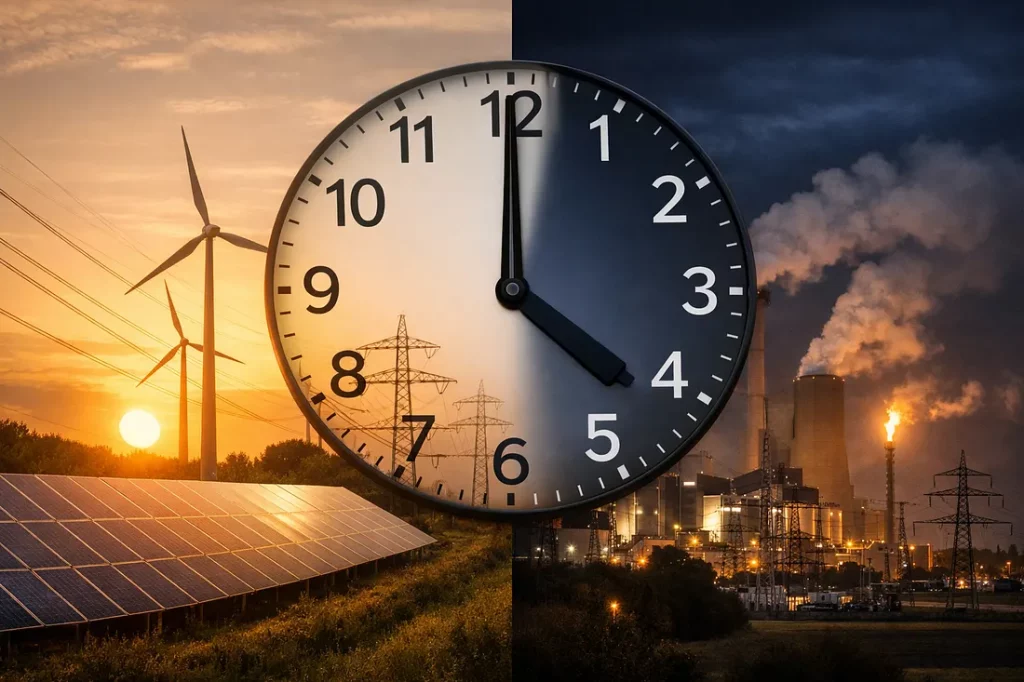
Consider what electrification does to load profiles. Electric vehicles are typically charged in the early evening, when people return home. Heat pumps work hardest on cold winter nights. Industrial processes often run on fixed production schedules, indifferent to wind patterns or solar cycles. In many systems, these periods already coincide with declining renewable output and rising reliance on thermal generation.
The result is subtle but significant. Peaks are reinforced rather than smoothed. Fossil units ramp harder and cycle more frequently. Gas turbines, designed to balance variability, become the backbone of flexibility. And when thermal plants operate in ramping mode, they do so less efficiently. Start-up emissions increase. Marginal carbon intensity rises. Meanwhile, midday solar is sometimes curtailed. Clean electricity is available, but there is insufficient flexible demand to absorb it. The system spills energy at noon and burns gas at dusk. Installed capacity grows, yet displacement plateaus.
From a distance, the transition looks linear: more renewables, fewer emissions. From inside the system, it looks different. Renewable energy expands, but the structure of demand keeps fossil balancing alive.
Over time, infrastructure responds to this rigidity. Transmission is reinforced to serve higher peaks. Additional peaking capacity is built to protect reliability. Capacity markets reward firm backup. These assets are long-lived. Once built, they shape system behavior for decades. Flexibility becomes something to retrofit rather than something designed in. This is where demand-side management stops being a behavioral footnote and becomes a structural necessity. Demand flexibility does not primarily mean using less electricity. It means using it differently. Charging vehicles when wind output is high. Pre-heating buildings when solar is abundant. Scheduling industrial loads dynamically. Aligning consumption with periods of low marginal carbon intensity.
When demand becomes elastic, curtailment falls. Fossil ramping declines. Peaks soften. The system breathes more evenly. Electrification begins to displace rather than amplify fossil dependence. The core issue is not whether electrification works. It does. The issue is whether growing electrified demand adapts to variable renewable supply, or forces fossil supply to adapt to it. Decarbonization is not simply a question of how much renewable capacity is built. It is a question of how well variable supply and growing electric demand are coordinated in time. If electrified demand remains rigid, fossil generation does not disappear. It reorganizes itself around variability.
Electrification without demand flexibility does not fail loudly. It locks in quietly.
And once the architecture hardens, carbon decline slows, not because renewables were insufficient, but because the system was never redesigned to let them lead.