Biochar as Evaporative Cooling: A Simple Idea for Hot, Dry Places
By George Kibuku – Carbon Markets Associate – Energy
In arid and semi-arid regions, the problem isn’t producing food.
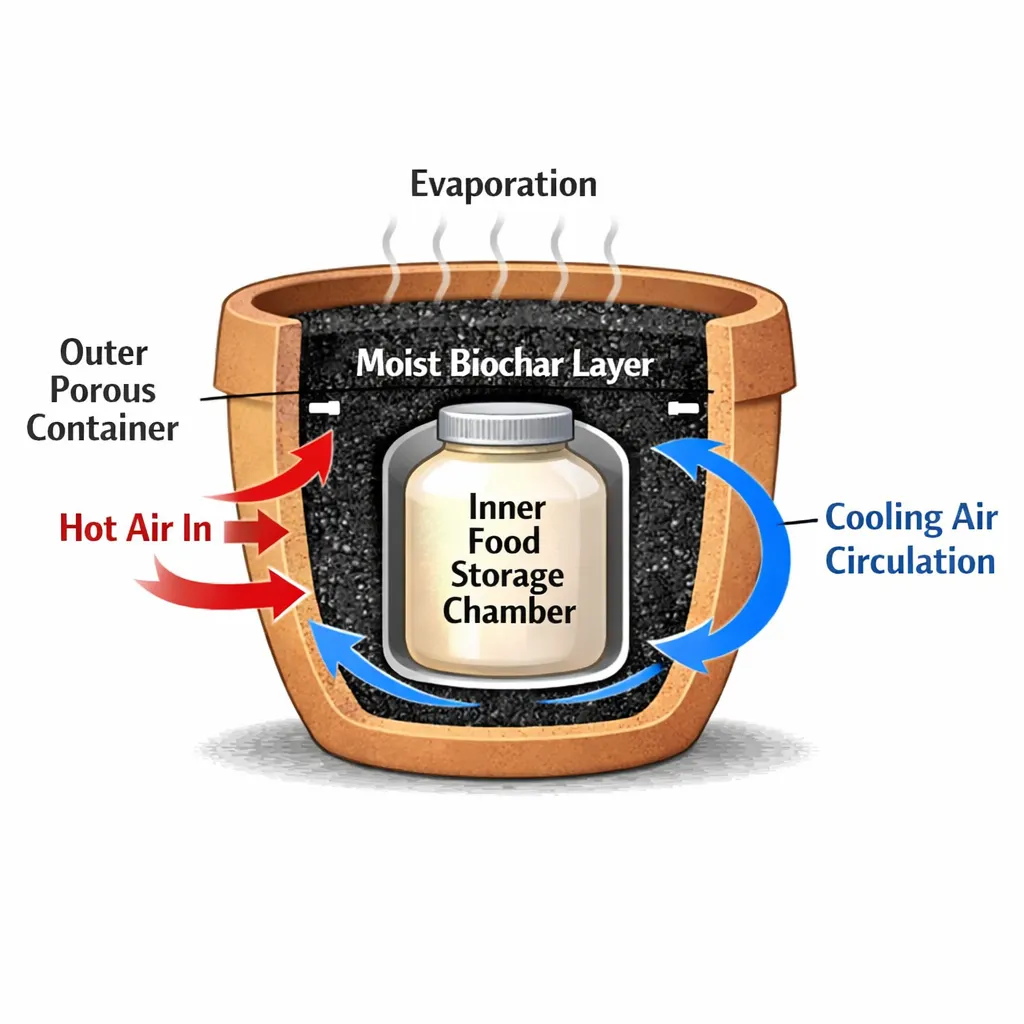
It’s keeping it cool long enough to matter. Milk spoils within hours. Vegetables lose value before they reach a buyer. Electricity is unreliable or nonexistent, and refrigeration — when it exists — is expensive, centralized, and fragile. Yet people have been cooling food in these environments for generations, quietly and effectively, without power. Evaporative cooling works because dry heat is predictable. When water evaporates, it absorbs heat. In low-humidity environments, this process is efficient and continuous. That’s why clay pot coolers, charcoal-lined boxes, and wet sacks over crates have remained in use across arid regions long after modern cold chains became the norm elsewhere.
The idea isn’t broken. The material is.
Charcoal has become the default cooling medium not because it’s ideal, but because it’s familiar and available. It holds some moisture and allows air to pass through, enough to make evaporative cooling work. But it also comes with costs that are increasingly hard to ignore: deforestation, smoke, odor, and short useful life. This is where biochar enters the picture, not as a technological leap, but as a quiet substitution.
Biochar behaves differently from charcoal in ways that matter for cooling. Its porous structure holds more water without collapsing. Air continues to flow even when it’s wet. Evaporation happens across a larger surface area, which means cooling lasts longer and stays more stable during peak heat.
In simple, practical terms:
Replace charcoal with biochar, and the same cooler works better. Field evidence from charcoal-based systems already shows temperature reductions of up to 10–15°C in dry climates. Biochar, with higher porosity and moisture retention, can meet or exceed this performance under the same conditions, without the same environmental downsides.
This matters most where heat directly translates into loss. Camel milk is a good example. Camel milk is often produced far from electricity and far from markets. By the time it reaches a collection point, hours may have passed in extreme temperatures. Even a modest extension in shelf life, half a day, a full day, can be the difference between selling and dumping. A biochar-based evaporative cooler doesn’t solve every problem in the camel milk value chain. But it solves a very specific one: buying time. Time to aggregate. Time to transport. Time to sell before spoilage sets in. And it does so using materials that can be produced locally, without grid power.
Biochar doesn’t require electricity to make. Simple pyrolysis systems can operate off-grid, using agricultural residues, invasive species, or animal waste as feedstock. Once produced, the same biochar can be used for months as a cooling medium. Here’s the part that’s often overlooked: when that cooling life ends, the biochar isn’t waste. It can be applied to soil, mixed into compost, or used in planting pits, not as a headline benefit, but as a second act. The cooling use doesn’t degrade it. It simply delays its return to the land.
That circularity is not the point of the idea, it’s the bonus.
The point is simpler.
In places where heat is constant and power is scarce, small material choices matter. Swapping charcoal for biochar in evaporative cooling systems is one of those choices. It doesn’t require behavior change, new infrastructure, or complex financing. It just asks a different question:
What if the things we already use to cope with heat could work a little better, and cost a little less to the landscape?
Sometimes, climate solutions don’t need to be louder. They just need to fit where life is already happening.